

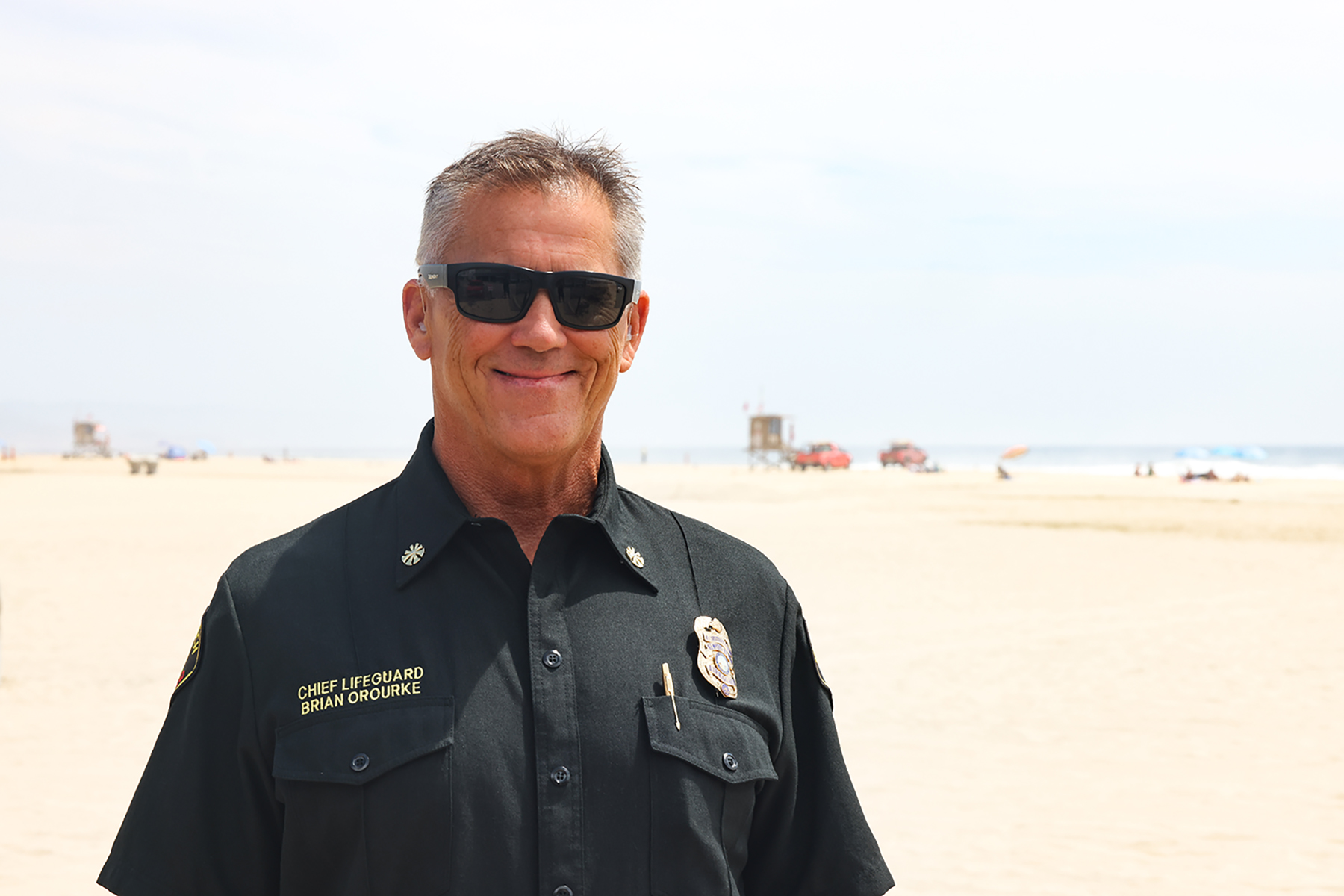
In his 39 years as a Newport Beach lifeguard, 59-year-old Brian O’Rourke has witnessed, marveled at, ridden, and battled just about every wave type known to oceanographers.
In his 39 years of scanning and patrolling sea and shore, he estimates that he’s saved more than 1,000 panicked persons of every mesomorphic description in every age group.
In those 39 years, he has marveled at the changes in beach culture, from fashion to behaviors.
And now, after the most “rewarding 39 years imaginable,” O’Rourke – the Assistant Chief Lifeguard Operations at City of Newport Beach Fire Department – is leaving the profession that has defined his life. Soon, he’ll salute the sea goodbye as he and his wife of 23 years, Monica, depart Newport to the greener environs in the mountains of Idaho.
At the age of 18, O’Rourke began lifeguarding at the placid lagoon of Newport Dunes, while attending Orange Coast College as a water polo athlete. The team’s assistant coach, himself a full-time Newport Beach lifeguard, suggested O’Rourke try out to become a lifeguard. Success came “the second time around,” as an injury interrupted his initial challenging training. While working full-time, O’Rourke earned his degree in Vocational Education with an emphasis on Life Safety and Emergency Management from Cal State University, Long Beach.
Throughout his university years, O’Rourke knew that his career path led to the beach and to becoming a full-time lifesaver.
O’Rourke lauded the recent heroic lifesaving efforts of 16-year-old Santa Cruz lifeguard Ryan Williams, whose heroism in saving a young child in wild surf was captured on video and circulated nationally, and which earned a presidential invitation to the White House.
But O’Rourke voiced, “Honestly, this is what all lifeguards do and with little fanfare.” Evidence of this is the number of average lives saved annually by Newport’s dedicated guards.
“On average, we save around 3,000 people a year. This year, we’ll probably surpass 4,000,” O’Rourke projected with obvious pride, but with understated humility.
“Newport Beach can be a very treacherous beach,” O’Rourke shared. “Obviously, we have the Wedge, plus we have several areas (along a six-mile beachfront) where we get very large waves and very strong rip tides.” Such a phenomenon makes for a “very dangerous job,”
“You’re put in situations with large, scary waves and very strong rips. Oftentimes, you’re held underwater while you’re really far off the beach and exhausted. You’re committed to saving a victim and yourself. There’s no quitting once you know you have to go after somebody,” O’Rourke emphasized.
He cites the heroic efforts of 33-year-old professional lifeguard Ben Carlson, who in 2014 died tragically and inexplicably while saving a male in 12-foot storm surf.
But overall, O’Rourke claims, Newport is a safe beach “if you remain aware.” Over the years, Newport averages one or two drownings annually; however, “We’ve had no drownings over the past several years.”
He advises repeatedly that all beachgoers swim near a lifeguard, plus seek information or advice about sea conditions or other safety concerns before wading or diving in.
Beach lifeguards are almost always seen with sausage-shaped floatation devices, which they drag behind them en route to a victim.
“Those floats are for the victims on which to rest,” O’Rourke said. “But the lifeguards use them too,” he admits. “If necessary, we’ll strap a victim to those floats if they are panicking so we don’t lose them underwater as we drag them back.”
The most difficult thing for an endangered swimmer is to “not panic,” O’Rourke claimed, recognizing how difficult panicking is to control. “I think that panic is the number one thing that gets people in trouble. And that can also get a lifeguard into trouble, as well.” To that end, O’Rourke shared, “Teaching our guards to help victims relax is a major part of our lifesaving efforts,” while also controlling their own adrenaline flow.
On a busy day, there may be more than 100,000 people frolicking at the beach, always requiring lifeguards to unceasingly scan. Fortunately, O’Rourke explained, lifeguard towers are spaced closely enough for zones of observation to overlap should assistance be needed. ”Our goal is to make sure everyone goes home safely at the end of the day,” O’Rourke asserted.
The basics of lifeguarding have remained unchanged since the profession began in the 1700s, when “lifesavers” would be sent out to rescue passengers and mariners in need, according to the “History of the Lifeguard,” on the website Panama Jack. These heroes evolved into the nonprofit United States Lifesaving Service, which in time became the United States Coast Guard.
Newport Beach has been home to a Coast Guard cutter since 1942, and currently homeports the 87-foot -long Narwhal, a Marine Protector Class coastal patrol boat.
By the 1800s, shipwrecks were rare, so the lifesaving services shifted their focus to the beach, especially as sandy seashores became prime recreation areas.
In the l920s, a variety of organizations began lifesaving training, including the YMCA and the American Red Cross. In the 1950s, lifesaving techniques expanded, especially with the invention of mouth-to-mouth resuscitation combined with chest compressions, known as CPR, or cardiopulmonary resuscitation. Over the years, technology has enhanced tools for saving lives. Those include everything from basic rubber gloves to the Heart Start defibrillator; from RWCs (Rescue Water Craft, synonymous with Sea Doos) to administrative systems, and advanced emergency medical training, O’Rourke shared. Still, none supplants hard physical preparation and exertion. For example,”It takes a team of at least several people to manhandle and position an 800-pound RWC in position to power beyond the surf to rescue a drowning person.
As he heads toward retirement, O’Rourke has reflected on his many lifesaving experiences, “too many to specifically recall,” he said. But he does recount his inaugural day serving on West Newport Tower 61.
“I’ll never forget that day, it was huge! Every lifeguard from 44th Street westward had at least 15 rescues. I just remember going out to rescue some people, then landing up nearly three-quarters of a mile from my tower, almost to Huntington Beach.”
Few professionals face the daily challenges that lifeguards do; O’Rourke doesn’t talk much about that. But what he does talk educationally and willingly about was the greatest challenge he ever faced — not in the surf, but in an exhausting and debilitating 10-month battle against non-Hodgkins Lymphoma, a cancer of the lymphatic system.
It started with a small lump in the neck, followed by inexplicable and progressive fatigue. By the time it had been identified, cancerous tumors had spread throughout his body. Intensive chemo followed, along with exhausting stem cell therapy. Of course, O’Rourke credits his doctors for miraculous care. But he also gives amazing credit for his survival to the loving support from both his wife and his lifeguard family. Not to be discounted, a warrior’s will to live can never be underestimated. He has been cancer-free for 10 years, but checks in every three months just to ensure that stability.
Although weakened after treatment, O’Rourke worked out diligently for months to the point where he thought he could retake the demanding lifeguard qualification test. As willpower dictated, he passed the challenge of the test, earning the deep respect of his coworkers who knew how difficult that must’ve been.
The Chief’s simple, freely given advice after his near-death experience: “If something bothers you, have it checked.”
It may take years to review his four decades of service and bring forth all that he has cherished within the lifeguard department. But two things stand out for him immediately: the trusted friends he has made along the way, and all his teammates who together have made the Newport Beach Lifeguard Department the most respected such service in the United States, and the honor of overseeing the nation’s largest Junior Lifeguard summer program.
Until he cranks his car to depart for Idaho, O’Rourke pledges to surf as many days as possible—doubtlessly near a lifeguard tower.