

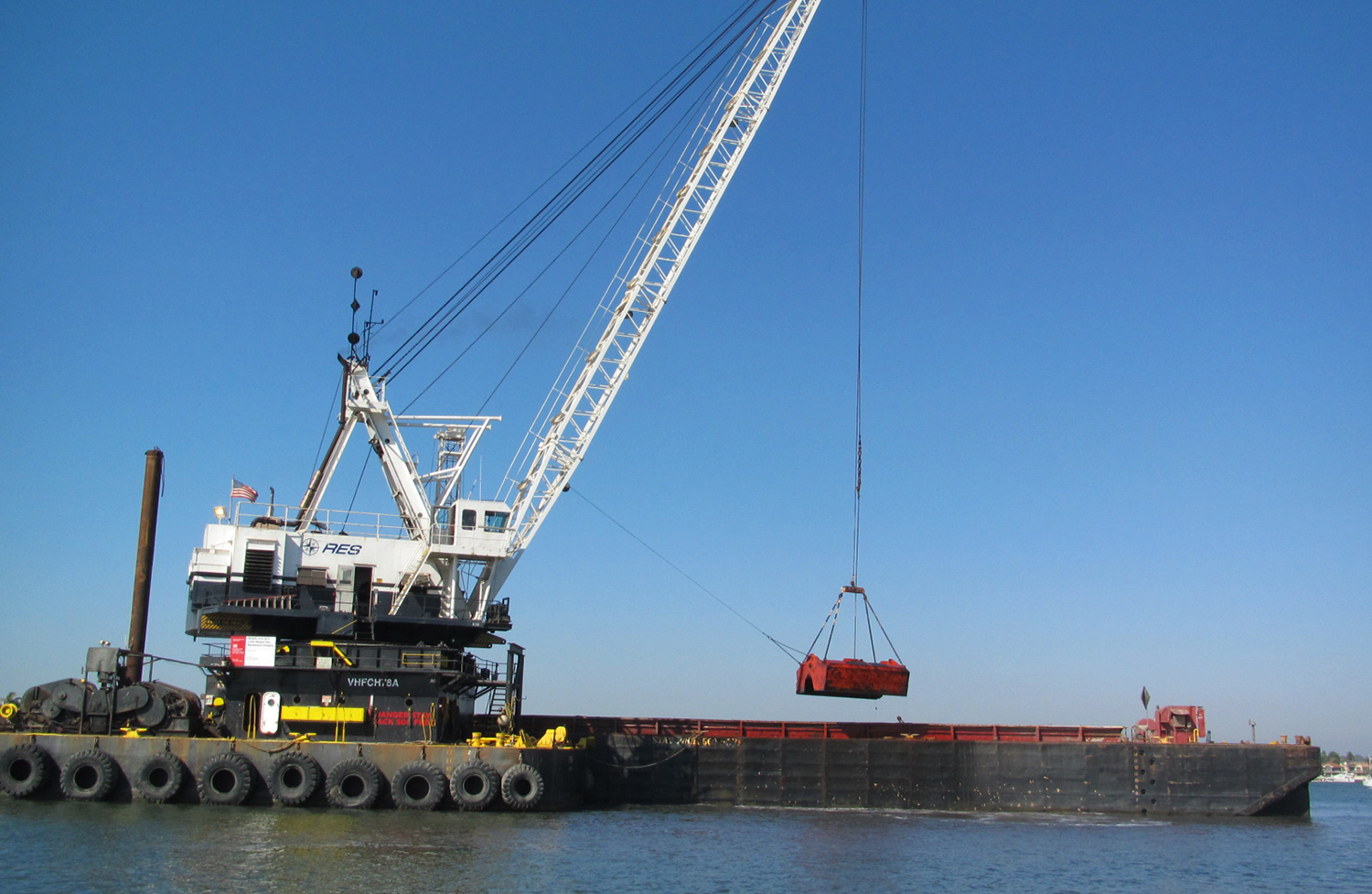
Look now, because it may be decades before Newport residents, boaters and visitors will ever again see a major dredging operation in Newport Harbor.
That is the prognostication of Public Works Manager Chris Miller, who’s in charge of all harbor-related capital projects and improvements, and who is overseeing the dredging of the Congressionally mandated depths of the “federal channels with the harbor.”
Since the 1930s, Newport Harbor has been an authorized harbor under Congressional federal control, so the feds still have the responsibility of maintaining the harbor.
Beginning last December, and projected to be contractually completed around September 26, of this year, the dredging operators, sinking a 24-cubic-yard bucket, will remove 900 thousand cubic yards of “legacy” material that has settled on the harbor bottom, most deposited when the Santa Ana River emptied into the bay at what is now the turning basin, and where deep-draft commercial vessels used to deliver materials and supplies to the area as late as the 1930s.
A cubic yard of unsaturated dirt weighs 2,000 pounds, and most of the gooey tonnage that has been floated six miles out on tug-towed scows is very old mud, Miller apprised. Newport’s total dredged sediment could weigh close to two billion pounds. For a weight comparison, Empire State Building weighs 730 million pounds. The scows’ capacity totals 3,000 cubic yards. The physical dredging operation and removal is contracted to R. E. State Engineering, Inc., who may very well be ahead of schedule,” stated Miller. For those who may want to expand their nautical knowledge, a “barge” is a scow on steroids.
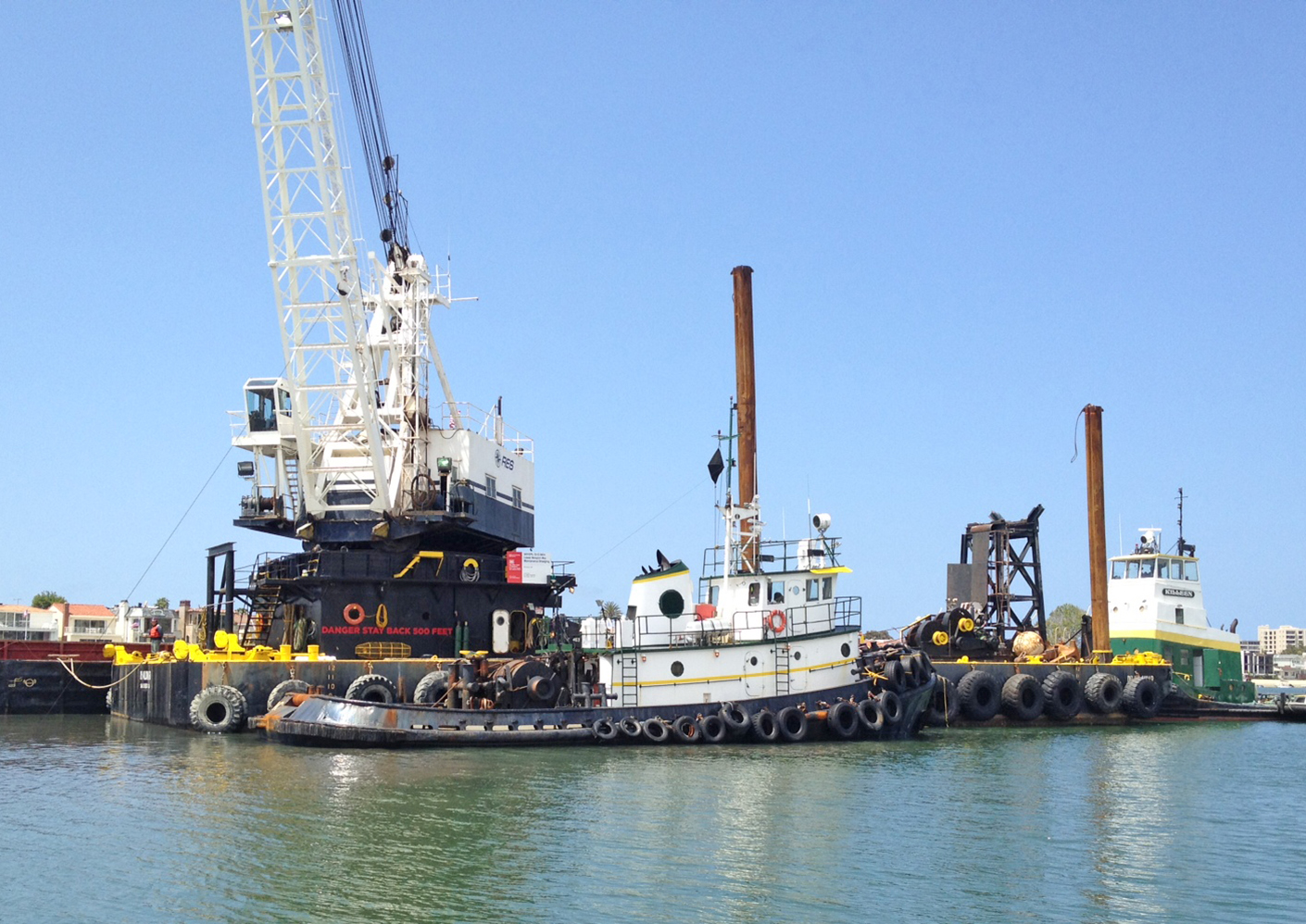
Although Newport Harbor is no longer utilized as a large-scale commercial freight port, it still is a business environment for fishing, charter boats, and related activities. Consequently, the main channel must be dredged and maintained at 20 feet depths, while likewise, the smaller channels will see depths of 10-feet and 15-feet. And though Newport Harbor is primarily a residential, commercial and recreational zone, a portion is home to both federal and local agencies: U. S. Coast Guard, Drug Enforcement Agency, and the Orange County Sheriff. All have jurisdiction throughout the harbor and, of course, offshore.
Securing funding was not easy, Miller apprised. “We had to pledge a partnership with the Feds to contribute to the federal coffers, plus we had to overcome the image that Newport was just a pleasure harbor.”

A part of Miller’s and his lobbying team’s presentation to Congress highlighted Newport’s footprint as a the largest small boat harbor in the western U.S; its position as an intrastate ferry “port;” the harbor’s tax contribution to the feds totaling more than $83 million; its position as a regionally significant harbor with the largest shipyards and fuel docks; it’s importance as a safe harbor and refuge; as well as the power of its political “voice” nationally.
Miller highlighted the important roles of his lobbying partners, former City Council members Marshall “Duffy” Duffield and Brad Avery, and former Harbor Commissioner Scott Cunningham.
Dredging does not come cheap: $21 million split between Newport and the federal government. Although Newport Harbor is a federal harbor, it is not considered a commercial port, where jumbo cargo and container ships tie up to load and unload. Newport’s closest big boy ports include San Diego, Long Beach/Los Angeles, Oakland and Stockton.
Environmental concerns have always been at the forefront of local government and multi-state and federal entities, both above and below the waterline. That includes, of course, the mud.
Sedimental Journey
Since the dredged sludge, both past and present, was to be deposited in an EPA-approved ocean disposal site six miles offshore, the “purity” of that had to be assured. More than a year — and $1.3 million for the preplanning process — was spent by Newport testing the sediment for any contaminants. And, yes, some contaminants were found, rendering that residue unsuitable for local disposal.
Fortunately, Newport found a depository 20 miles up the coast to the Port of Long Beach, where the port is allowing placement of the “approved” material to help create a landfill for an expanded commercial container storage facility. To that end, Newport has been accelerating dredging in the upper reaches of the bay (sometimes seven days a week) in order to meet the must-fill timelines set by the project managers in Long Beach.
Operating the dredge may seem like a slam dunk operation, but a crane operator is somewhat akin to a surgeon having to carefully preserve healthy tissue. Throughout the process, native eelgrass, plus various other legacy materials and sea life, must be left in place; constant monitoring assures the process.
The political complexities of reaching the point where the sky-piercing crane first dips its massive scoop is that part of the dredging process that remains mostly unseen. But then, few, if any, will ever see the physical result of Newport’s huge effort to keep the channels at their mandated depth.
Report on Upper Newport Bay
For decades, San Diego Creek has drained fresh waters from many Orange County tributaries into the Upper Bay. As human populations expanded, so had the amount of both manmade and natural litter and pollutants, which flowed nonstop downstream into the Upper Newport Bay Marine Preserve—much of it left high-and-dry or entangled in the tidal march vegetation as tides ebbed; or it was carried by rains, winds and currents into the Newport Harbor and ocean beyond.
What oftentimes looked like colorful birds resting or feeding turned out to be the trashy accumulations of a careless population.
But Newport, along with a variety of federal, state and local agencies, as well as generous funding entities such as the Ocean Protection Council, Orange County Transportation Authority and the Department of Water Resources, came up with a solution: the installation of the Newport Bay Interceptor in March, 2025.
One of only a few in operation, the Interceptor is designed to autonomously interrupt the flow of debris into the bay and ocean. Flowing materials are trapped in floating booms, which then direct the trash onto a trash wheel (similar to a Ferris wheel) that rotates the contents onto conveyor belts which move the stuff into trash bins. Those are collected when full.
During the past rainy season, the Interceptor captured an estimate 50-60 cubic yards of debris, 80 percent described as “vegetative debris.” It is projected to trap trash/debris in the range of 200-300 cubic yards in 2026.
The Interceptor, based on a design by inventor John Kelly of Baltimore, MD, shows how one person’s natural resourcefulness can successfully preserve Newport’s famous natural resource.